
The Ethics of photographing Steller Eagles
- Ashok Nair
- 1 day ago
- 5 min read
First, let’s get the cold numbers out of the way.
The Steller eagle is the world’s heaviest bird - they can weigh upto 10kgs.
Their length can be between 2 and 3 feet.
A wing span that can go upto 8 feet to go with that.
Take a moment and read those numbers again. Digest them.
Look around you and picture the space that a Steller eagle with it’s wings outstretched can occupy in the room you are reading this in.
However, all that is not still the most impressive part of the Stellar eagle.
It probably has the largest bill amongst any eagle. That bright yellow, evilly curving, intimidating beak is what captures your attention first. It simply dominates all other aspects of the Steller eagle. And as you stay captivated by that yellow expanse ,you slowly notice the eyes. Two orbs resting just above the beak. Unblinking. Staring at you. The eyes make the Steller almost look perpetually angry about something.
It is one heck of a bird for sure.
I was in Hokkaido last year to see them.
They are not residents of Hokkaido though. They come visiting during winter. Home is the beautiful and remote Kamchatka in Russia. However, in winter, as the sea freezes in Russia and fishing becomes difficult, these birds follow the drift ice as it floats towards Hokkaido.
The Steller eagles use these floating ice as a perch while resting between fishing or feasting on their catch. These birds are rather brilliant at fishing but like we have read about the Orcas in the Arctic, have also learnt to leverage humans well. They too tend to follow the commercial fishing boats and as the fishermen throw overboard the unwanted fish, the Steller swoops in for a quick meal.
Of course, every place is rather quick these days to identify an opportunity to make a buck from the large hordes of photographers and now, there are numerous boats that leave at dawn looking out for the nearest drift ice. These boats are not fishermen throwing off the unwanted fish from their catch but instead go with a few crates of only the unwanted fish which they throw overboard and it's some sight to see these impressive birds swoop in for an easy meal.
Of course, there are many Steller eagles around and the white tailed eagles too and fights often break out between them mid air or on the land for every tiny scrap of food.
But photographing these birds isn’t an easy task. What happens around the boats is a pure frenzy of feeding. You have birds swooping down from all directions and, these guys are really fast! You can’t dream of getting a good image after you notice a bird diving. By the time you move your camera there and compose, the bird would be flying off with its meal. You need to identify a bird that appears as if it is about to swoop in and then follow it’s trajectory. And it's far easier to say than actually execute. You would often identify the wrong bird which doesn't swoop in and often don't track it long enough as you just naturally swing your camera to where you see another bird swooping in.
The breathless action around you is just exhausting.
Your mind is racing and it is only after some time and not without considerable effort that you force yourself to slow down and search for images that look a little different. Maybe use the drift ice a little differently to capture just the beak. Or blur the foreground to such an extent that you get shadowy figures which could be of any bird, if it had not been for that impressive beak.
Beyond the question on composition and creating images with a difference there was a larger question to which I still don’t have an answer – is it ethical to go on such rides?
We did have a small discussion around it while planning the trip and I had voted in favor.
Some background first. Baiting is not considered to be a healthy practice and feeding fish for photography is baiting.
Why is it wrong?
The biggest fear is that by frequently providing food for wild animals you are changing their natural behavior. They grow dependent on humans and lose their natural hunting skills and their survival instincts. They could also get very familiar with humans and that is never a good thing since they might not be able to differentiate between a poacher and a tourist. Many animals fighting for the scraps that are thrown at them could lead to more fighting and injuries than would happen naturally.
When we were debating, I was of the opinion that we are not really affecting the birds’ natural ability. They are being fed for just about an hour or so each day and only for a few days in winter. The rest of the time they have to fend for themselves. Ergo, their natural skills are not at risk of being diluted.
One could also argue that the number of fish left in the seas has dropped significantly due to us humans. The Steller eagle is an endangered bird. (There are only around 5000 of them left.) If they get a little food during the brutal winter months, won’t it help them especially when you consider that it still won’t dilute their hunting skills ? Won't we be balancing out the harm that we have already caused? Plus there is the economic benefit this provides for the local community.
While I had voted for it, now I am not so sure.
It's still not a natural act. There is much that we don't know about nature and the wild and it is quite plausible that we are impacting them negatively in some way. Will it impact the younger ones differently ? Will they learn how to always depend on humans too during winters ? As photographers we love to shoot the mid air fights - how natural is that ? What about the risk of injuries ? Is there a possibility of faster transmission of diseases should there be an outbreak because of the high number of birds that appear for the boats? Would the nutrition levels that gets provided by the unwanted fish match what they would get if they had naturally fished?
Or are these merely theoretical concerns that can't outweigh the simple fact that this provides food for an endangered species during a brutally tough period ?
I don’t have the answer.
I would love to know what you think.

The beak and the eye. I love these birds, but don't you feel that
there is something malevolent about that gaze ? :)

Those wings could span 8 feet. Now imagine such a bird wings fully outstretched
walking purposefully towards you

There is something incredibly magnificent about these birds, isn't there ?

It's tough to photograph these birds swooping in...ideally that splash should have been a little more into the frame. But, try getting it right !!

Cos, for one, they are infernally fast !!!
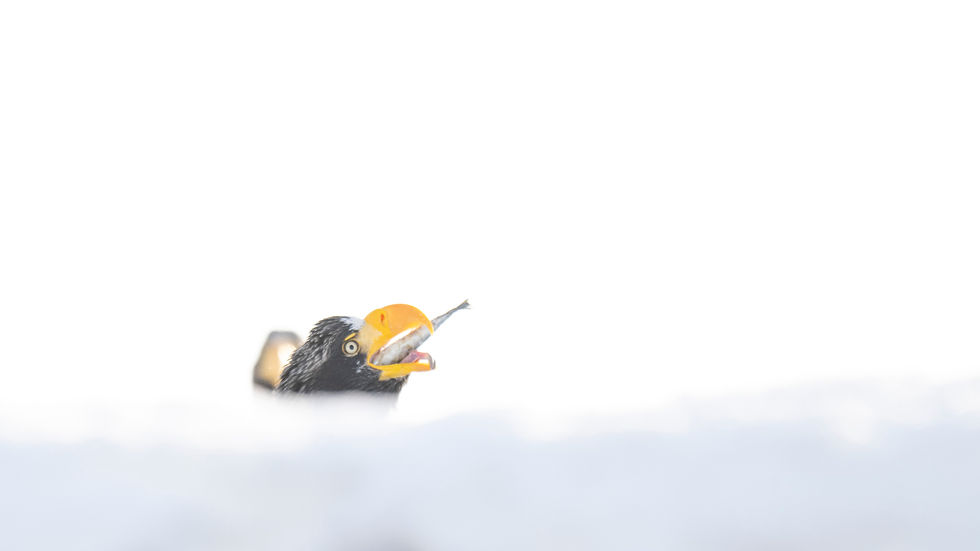
Gulp !
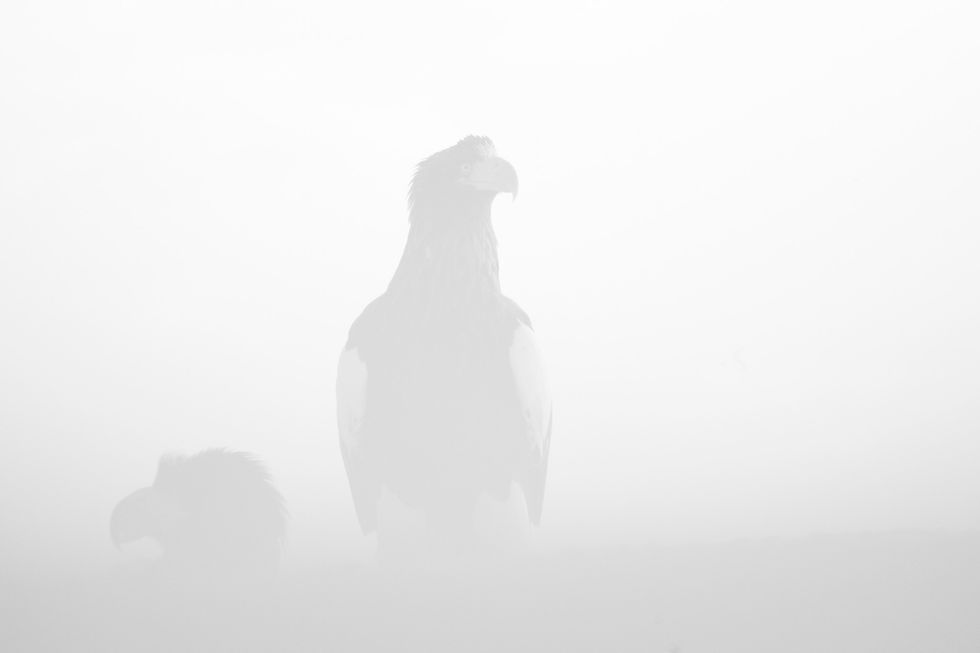
I am much fascinated by those beaks

But the larger question remains...is it right to feed them, even if it's occasional?

Or do we leave them untouched in their beautiful world with all its brutal realities?
Cheers !
Ashok


Comments